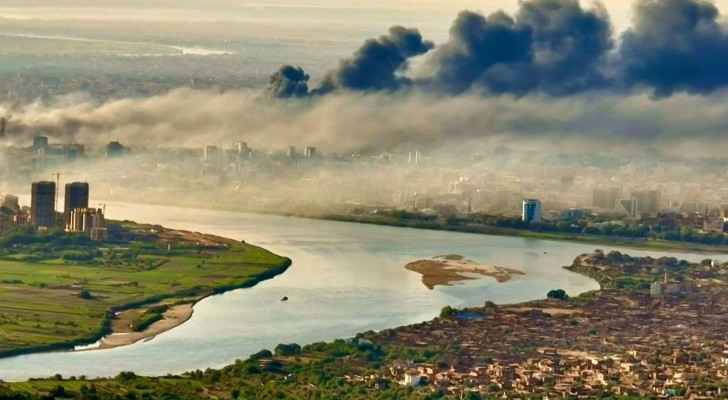
United power ... Sudan's Chinese backed Merowe Dam Abu Shouk refugee camp Darfur

Sudan Watch

Monday, November 16, 2009

Security situation in Darfur - Nov 12, 2009

EL FASHER (DARFUR), Sudan, November 16, 2009/APO/
UNAMID Daily Media Brief 2009-11-15
Filipino civilian police receive peacekeeping medals

On Saturday 14 October, 91 Filipino civilian police officers received peacekeeping medals as a tribute for their activities in the African Union -United Nations Mission in Darfur (UNAMID).

In his message to the policemen and women, Joint Special Representative ad interim (JSR a.i.), Mr. Henry K. Anyidoho, commended them for their disciplined approach to their duties, selflessness and substantial contribution to the peace process in Darfur.

Police Chief Superintendents of the Philippines, Mr. Vitorio Caragan and Mr. Reynaldo Rafal, were also special guests at the ceremony.

In brief remarks, Mr. Rafal stated that his country was proud to be part of this “worthy endeavour” of peacekeeping to bring peace and development to Darfur.

“As we all know, peacekeeping is a unique and dynamic instrument to help countries torn by conflict to create the conditions for lasting peace. This continuous effort of sending our police force only demonstrates the Philippines’ strong commitment to helping the people of Darfur,” he said.

One hundred and sixty-three police advisors, including 9 women, from the Philippines are currently deployed in UNAMID.

Meanwhile, 99 new police officers from Bangladesh and 1 from Togo arrived in the Mission on Saturday. This pushes the total number of police advisors in UNAMID to 2,844 representing over 75 per cent of the authorized deployment of civilian police. Some 1,816 policemen and women are based in 12 formed police units (FPUs). These represent more than 68 per cent of the authorized number to be deployed in a total of 19 FPUs.

SOURCE: United Nations – African Union Mission in Darfur (UNAMID)

Labels:

Mo Ibrahim's mobile revolution - 'Africa must think big to thrive'

From BBC News 20:14 GMT, Sunday, 15 November 2009:
'Africa must think big to thrive'
Mo Ibrahim

Mo Ibrahim was speaking at a two-day forum in Dar es Salaam

Many African states are too small to continue to exist independently, Sudan-born magnate Mo Ibrahim has told a conference in Tanzania.

Mr Ibrahim said the idea that 53 small African countries thought they could compete with China, India, Europe and the US was a "fallacy".

Trade within Africa accounts for just 4-5% of the continent's international trade, something that is "not viable".

The tycoon said Africa "needs scale" to compete with the big economic players.

"We need scale and we need that now - not tomorrow, the next year or the year after."

The BBC's Peter Greste in Nairobi says Mr Ibrahim was referring to economic integration rather than political unification.

Mo Ibrahim's mobile revolution

Speaking to an audience that included Tanzanian President Jakaya Kikwete, Mr Ibrahim said Africans were poor, hungry and going without.

"Something is drastically wrong. I think we have the right to ask our leaders: are they really serious?" he said.

Mr Ibrahim surprised African leaders last month when the $5m (£2.9m) Ibrahim prize for good governance was withheld.

The prize is given to a democratically elected leader from sub-Saharan Africa who has served their term and left office.

South Africa's Thabo Mbeki and Ghana's John Kufuor had been among the favourites.
MO IBRAHIM
Sudan-born mobile phone entrepreneur
Moved to UK in 1974 to study
By 1983, director of BT Cellnet
Founded Mobile Systems International, which he sold to Marconi in 2000
Then set up Celtel, used by 25m Africans
2007: Started African leadership prize
2008: Named UK's most influential black person

SEE ALSO

RELATED INTERNET LINKS
The BBC is not responsible for the content of external internet sites

Labels: ,

UN peacekeeping medals awarded to 91 Filipino police advisers serving with UN-AU Mission in Darfur Sudan

The United Nations awarded peacekeeping medals to 91 officers of the Philippine National Police (PNP) serving as police advisers with the United Nations-African Union Hybrid Mission in Darfur (UNAMID).

RP Peacekeepers in Darfur Honoured

Photo shows UNAMID Joint Special Representative Henry Anyidoho reviewing the Philippine police contingent during ceremonies in El Fasher, Sudan, where he commended the Filipino peacekeepers for their disciplined approach to their duties, selflessness and substantial contribution to the peace process in Darfur.

The Philippines has a total of 163 police officers, including nine women, serving in UNAMID. (Photo by Nektarios Markogiannis)

Source: RP Peacekeepers in Darfur Honored, November 16, 2009 by DFA-PISU / dfa.gov.ph

Labels: , , , ,

Saturday, November 14, 2009

NEW PUBLICATION: Peace and Security Council Report - November 2009

Here is a copy of an email received
From: Security Council Report
Subject: Peace & Security Council Report
12 November 2009

Readers of Security Council Report may be interested to know of the recent launch in Addis Ababa of a similar publication designed to provide monthly information about the work of the AU Peace and Security Council. It is called the "Peace and Security Council Report" (To access the November 2009 edition you can click here).

Peace and Security Council Report is produced and published by the Addis Ababa office of the Institute for Security Studies of South Africa. Security Council Report has assisted ISS with the development of this concept and it is pleased that ISS has taken SCR's Monthly Forecast as a model. We are pleased to have been able to help.

You are able to subscribe to regularly receive the Peace and Securty Council Report by clicking here.

Further details may be obtained from the programme directly at:
Peace and Security Council Report Programme
Institute for Security Studies
PO Box 2329
Addis Ababa, Ethiopia
Tel: +251-11-372-11-54
Fax: +251-11-372-59-54

_______________________________________________

Security Council Report
One Dag Hammarskjöld Plaza
885 Second Avenue at 48th Street, 31st Floor
New York NY 10017

Tel: 212.759.9429 • Fax: 212.759.4038

contact@securitycouncilreport.org
www.securitycouncilreport.org
Cross-posted to Congo Watch and Uganda Watch and Ethiopia Watch and Kenya Watch.

Labels:

Friday, November 13, 2009

IMPORTANT NEWS: Some Sudanese living abroad may vote in elections - Ten arrested for impersonating registration officials in Rumbek, Southern Sudan

Report by Sudan Radio Service, Thursday, November 12, 2009:
Some Sudanese Living Abroad May Vote in Elections
(Nairobi) - Sudanese living in Kenya, Uganda, South Africa and Malaysia will now be able to register for the elections scheduled for 2010.

The National Election Commission had earlier exempted some countries from participating in the voter registration exercise which started on November 1.

The Sudanese Ambassador to Kenya, Majok Guandong, told Sudan Radio Service in Nairobi on Thursday that he had received a circular from the NEC instructing him to start the voter registration. exercise in Kenya.

[Majok Guandong]: “Yes it is true, the news came yesterday morning (Wednesday) that the NEC has allowed us to establish voter registration centers in Kenya, Uganda, South Africa and Malaysia. So since yesterday we have been informing the Sudanese who are residing here, starting from tomorrow (Friday). The registration process will start at the Embassy and the GOSS liaison office. This is good news, because it is a constitutional right for the Sudanese to vote in the elections.”

Majok Guandong said that the registration period will be extended to compensate for the late start. He emphasized that the exercise will take 30 days, as required by NEC.

[Guandong]: “If we start tomorrow (Friday), we will be counting the days we have missed since the official start day, because it should be 30 days as scheduled. Secondly, all the documents are available at the Sudanese Embassy, and all Sudanese have the right. Since 1997, more than 5000 Sudanese have managed to get official documents, the passport, identity cards etc. The process is still on. So they have the right, if they need any official documents, there is no problem at all.”

Earlier, the deputy chairman of the NEC, Abdullah Ahmed Abdullah, told Sudan Radio Service that NEC was only concentrating on the countries with large Sudanese populations.

The countrywide voter registration exercise is scheduled to finish at the end of November.
- - -

Report by Sudan Radio Service, Thursday, November 12, 2009:
Ten Arrested for Impersonating Registration Officials in Rumbek
(Rumbek) - Ten people posing as registration officers have been arrested in Rumbek, Lakes state.

The 10 are under police custody as investigations are going on. They are being held for registering voters, collecting people’s identification and convincing people not to register at the official registration centers set up by the state High Elections Commission.

Our correspondent in Rumbek, Mageng Wade, sent this report.

[Mageng Wade]: “These people said that they were being sent and given money by the NCP to come and register people locally in order to prevent them from registering for the elections next year. So that is the agenda behind the registration of people in their houses.”

Rumbek Central county commissioner Abraham Akol Bol also spoke to Sudan Radio Service.

[Abraham Akol] “They have been arrested by the police and they are now under police investigation and we have not yet received information from the police whether this group belongs to a political party. They were trying to register people and were telling them not to go to the registration centers because they had already been registered. They also took ID cards from the citizens, those who tried to register but the culprits were found by police and they are now under investigation.”

The deputy governor of Lakes state, David Ngok, said that the people are trying to sabotage both the voter registration exercise and the elections.

[David Ngok]: “If there are some people who are trying to sabotage the voter registration process then they are also sabotaging the elections. We will not tolerate this as the government because this is government policy and it’s part of the CPA and the constitution so we will not allow them to do it.”

The deputy governor of Lakes state, David Ngok, spoke to Sudan Radio Service on Thursday
Click on 'Election' label (here below at Sudan Watch) to read news report Nov. 10, 2009, entitled "SSDF to sue NEC for denying Sudanese in Kenya, Uganda and Ethiopia a chance to register as voters in the general elections"

Cross-posted to Uganda Watch and Kenya Watch and Ethiopia Watch and Egypt Watch and Congo Watch.
- - -

UPDATE: From Sudan Tribune by Ngor Arol Garang, Friday, Nov. 13, 2009:
National election board accepts additional countries for Sudanese Diasporas
November 12, 2009 (MALAKAL) — The National Election Commission (NEC) of Sudan today confirmed acceptance of additional countries to the previous list for registration and voting to enable Sudanese abroad to participate in the upcoming elections next year.

Following the publication of a list of countries comprised mostly the Golf countries where the members of the Sudanese Diaspora are from northern Sudan, the SPLM asked to take in consideration African countries where Southerners reside massively.

The initial list includes Kuwait, United Arab Emirates, Kingdom of Saudi Arabia, Egypt, Qatar, Sultanate of Oman, Bahrain, the UK, Belgium (for all Western Europe) and Washington, New York, Los Angles for the USA.

"We have allocated more registration and voting centers in Africa and Asia, said Abel Alier, NEC chairman at Malakal airport as he was en route to Khartoum after inspecting southern states voter registration centers.

Countries newly agreed upon for inclusion by the two parties in Africa includes Uganda, Kenya, and South Africa as well as and Malaysia, he said adding discussions are underway to add other neighboring countries.

Therefore, as commission, "we request Sudanese people residing in those countries to immediately establish contacts with the Sudanese embassies and other designated offices for registration," he emphasized.

Asked why being selective with countries hosting number of Sudanese people abroad to participate in the ongoing voter registration, he said, national election commission gets approval of countries to be included in the registration process from the presidency.

"The Presidency is the highest authority which decides on issues pertaining to country affairs such as voter registration," he commented expressing wishes all Sudanese people abroad open registration centers.

However, he was quick to say the Commission tries its best to ensure inclusion of more centers so that every Sudanese participates in the upcoming elections.

He said constitution allows participation of legally registered citizens to elect their leaders in the upcoming April 2010 elections.

"If you are not registered, it will be hard to vote for the person one sees as leader," he said adding voter registration remains opened to the last day of November 2009.

Alier also requested local authorities to give logistical supports to voter registration teams. He also acknowledged assistance being rendered by United Nation Mission in Sudan in transportation of voter registration materials and teams in where government supports is required.

"UNMIS is greatly supporting registration process in water zones and areas without good roads mostly in the southern part of the country and transitional areas," he stressed.

Labels: ,

US Sudan envoy Gration & Ask U.S. - "Innovative Engagement with Advocacy Groups on Sudan"

Email from US Department of State:
Sudan Updates: “Innovative Engagement with Advocacy Groups on Sudan”
Thu, 12 Nov 2009 16:06:25 -0600
"Innovative Engagement with Advocacy Groups on Sudan"

Scott Gration
Special Envoy to Sudan
Washington, DC
November 12, 2009


On Tuesday, I participated in the ‘Ask U.S.’ live stream video question and answer session at the White House. Samantha Power, NSC Senior Director for Multilateral Affairs, and I answered questions posed to us by Jerry Fowler, the President of the Save Darfur Coalition, and Layla Amjadi, the Student Director of Stand (the student-led division of the Genocide Intervention Network). In the lead up to this event, the Save Darfur Coalition and STAND asked their members to both vote on which questions would be asked and to submit additional questions for consideration. We are eager to continue an active and robust dialogue with the advocacy community, and this unique event allowed us to engage directly with thousands of members of the Save Darfur Coalition and STAND.

The questions that Jerry and Layla posed touched upon a range of pressing concerns, inquiring about the administration's benchmarks for incentives and pressures, the circumstances in which internally displaced persons in Darfur might return home, the risks surrounding the 2010 elections in south Sudan, the importance of engaging China and Russia on the path forward, and the indispensability of including Sudanese civil society in the peace process. I found the exchange to be extremely useful and hope those who followed it online did as well.

A video link of the event is below if you were not able to watch it live on Tuesday.

http://www.youtube.com/watch?v=aNSXeMkiZ_M
[end of email]

Labels: , ,

Blair on China (Thomas P.M. Barnett) - China's New Cultural Revolution (Tony Blair)

Copy of blog post by Thomas P.M. Barnett Nov. 12, 2009:

Thomas P.M. Barnett
Blair on China
OP-ED: China's New Cultural Revolution, By TONY BLAIR, Wall Street Journal, October 9, 2009

A truly magnificent piece by Blair (or his writers) that provides a lot of nice perspective of the sort I favor:

My fave section:
Prior to 1949, China was a deeply riven and unequal society. There was a reason for the civil war and the multiple invasions of foreign powers. There was a reason for the upheaval of 1949. In the first 30 years came the completion of the revolution and the establishment of the People's Republic. But then came the Cultural Revolution.
It is difficult for us to grasp the pain of that period, when China closed down and engaged in a bizarre and cruel experiment that left scars, even to this day, on those who experienced it--including many in the present leadership. Talk to those who lived during that time, when reason was turned on its head, when survival depended on the whim of officialdom, and when all independent thought was snuffed out, and you will understand how momentous the change has been since then.

The opening up of China has its ups and downs. But over the past 25 years, the number of people below the World Bank poverty line has fallen by over 80%, GDP per head has more than doubled, and Chinese entrepreneurs are among the most innovative in the world.

China is now the world's largest market for automobile sales, but it is also investing heavily in green vehicles. It is the world's second largest market for wind turbines and the third largest in solar power. Over the next decade, it will almost double its energy output from renewable sources, its cities will change much of their lighting to LEDs, and it will aim to peak its emissions in 2030.

China's universities are forging partnerships with the best of their counterparts in the West. And China is turning out more science and engineering graduates than the whole of Europe put together.
Worth reading.

(Thanks: Michael S. Smith II)

Posted by Thomas P.M. Barnett on November 12, 2009
Click here to read Dr Barnett's bio.
- - -

Copy of op-ed from The Wall Street Journal
China's New Cultural Revolution
By TONY BLAIR
October 09, 2009, 4:22 A.M. ET
Yesterday, just a week after the 60th anniversary celebrations of the People's Republic, China kicked off its first World Media Summit. It shows how far China has come—and how far it has to go.

First, understand the problem. We all know China is a nation of 1.3 billion people, but that is just a statistic. Think of how we regard the United States—how different California is from Ohio, for example. Then quadruple it. Think of trying to meld China's 56 native ethnic groupings into one cohesive state. Think of the disaster, not just to the Chinese, but to ourselves, if it fractured.

Understand also how dramatic and daunting the challenge of China's development is. The U.S. has 4% of its population employed in agriculture. Almost 60% of Chinese make their livelihood farming, and more than 150 million live on $1 a day. They need to shift from farming to industry, and they need to do so desperately. The East Coast of China, especially around Beijing, Shanghai and Guangzhou, may look, in parts, like the First World. But rural China, inland and to the West, is in the beginning stages of development. It will have to change at a pace the world has never seen before.

China's New Cultural Revolution (Tony Blair)

Photo: Old and new. (Associated Press)

Are China's leaders concerned about ensuring that this happens with minimum chaos and maximum stability? Of course, and so they should be. Disorder is their enemy and ours.

Today, we analyze feverishly whether China will be able to help rebalance the world economy; whether it will play its full part in the Copenhagen negotiations on climate change; and what its position may be on Iran. Imagine we were analyzing the consequences of a threat to China's stability and cohesion. And then be glad we are not.

None of this means that we should stop posing tough questions to China's leaders. It simply means that we should appreciate how their country looks to them from the inside. We may criticize the speed of political reform, and raise concerns about human rights and the rule of law. But we should at least understand that their political and economic endeavor is unique in human history. Its magnitude is beyond the comprehension of most Western leaders, and its complexity should be recognized.

Prior to 1949, China was a deeply riven and unequal society. There was a reason for the civil war and the multiple invasions of foreign powers. There was a reason for the upheaval of 1949. In the first 30 years came the completion of the revolution and the establishment of the People's Republic. But then came the Cultural Revolution.

It is difficult for us to grasp the pain of that period, when China closed down and engaged in a bizarre and cruel experiment that left scars, even to this day, on those who experienced it—including many in the present leadership. Talk to those who lived during that time, when reason was turned on its head, when survival depended on the whim of officialdom, and when all independent thought was snuffed out, and you will understand how momentous the change has been since then.

The opening up of China has its ups and downs. But over the past 25 years, the number of people below the World Bank poverty line has fallen by over 80%, GDP per head has more than doubled, and Chinese entrepreneurs are among the most innovative in the world.

China is now the world's largest market for automobile sales, but it is also investing heavily in green vehicles. It is the world's second largest market for wind turbines and the third largest in solar power. Over the next decade, it will almost double its energy output from renewable sources, its cities will change much of their lighting to LEDs, and it will aim to peak its emissions in 2030.

China's universities are forging partnerships with the best of their counterparts in the West. And China is turning out more science and engineering graduates than the whole of Europe put together.

There is a new cadre of people coming to the fore within government. Conversations with Chinese leaders today—at the provincial, as well as the central government level—are a world away from the stilted, pro forma exchanges I remember on my first visit 20 years ago.

However, one of the most interesting aspects of modern China is how the narrative of China, its history and its future, is being reframed. Listen to people in China today—and not only in government—and you can see that even amid the celebrations of the 60 years of the People's Republic, China is rediscovering its history and reorienting its future as a result.

Naturally, the 60 years of the Republic and what it has done are extolled. But increasingly, there is an interest in and reverence for China's ancient civilization as well as its post-1949 transformation.

Confucius, the marvels of the Tang dynasty, calligraphy, the beauty of traditional Chinese painting and literature—all of this infuses the speeches, commentary and discourse of contemporary Chinese life. Chinese films, art, fashion and pop music are thriving. There is a new Cultural Revolution taking place in 21st century China, and it is a lot healthier than the old.

This provides those of us outside China with an opportunity. How China changes will impact profoundly how we change. Our obligation is to treat China as a partner as we determine together the way the world will work in the future. If we treat China as our equal, China can be our economic, political and cultural ally. That is an opportunity that is worth effort.

A few weeks ago, when I was in Guizhou province outside Guiyang city, standing in a small village to see a pilot project in solar lighting, I reflected on what I had seen. I had seen the city center, with its fashion shops like Christian Dior and its bustling nightlife, but also housing tenements urgently in need of renovation. I had witnessed a stunning music and dance show celebrating the region's indigenous heritage. I met the Muslim governor. And in the village, I saw newer homes, but also many that were as poor as some in Africa.

As I walked around, the local people at first hung back. But then as I reached out, they reached back. Within minutes, we were taking photos and speaking freely. OK, it wasn't like my old constituency in Sedgefield in the northeast of England. But it wasn't North Korea either. The relationship between government and governed in China is changing, and for the better.

So when we reflect on China's last 60 years, reflect by all means on how far they have to go. But spare a thought for how far they have come. And then figure out how we can help.

Mr. Blair was Prime Minister of Great Britain from 1997-2007.
Cross-posted to my blogs China Tibet Watch and Blair Foundation Watch

Labels: ,

Thursday, November 12, 2009

DDDC Sudan: Darfur civil society to participate in Doha peace talks

Source: Darfur Darfur Dialogue & Consultation (DDDC)
Date: 11 Nov 2009 (with thanks to ReliefWeb)
KHARTOUM, SUDAN – For a host of reasons, feeding the views of Darfur civil society into the Darfur peace process has been a challenge. A recent breakthrough in the ongoing Doha Darfur peace talks, however, has created a civil society track that has long been absent.

The Technical Workshop on Darfur Peace held in Doha, Qatar, October 12 – 14, 2009, and co–chaired by Qatari State Minister for Foreign Affairs, Ahmed bin Abdalla Al–Mahmoud, and the head of the African Union – United Nation's Joint Mediation Support Team (JMST), Ambassador Djibril Bassolé, "to discuss and propose the best ways to accelerate the peace process to reach a comprehensive resolution for the conflict in Darfur," adopted a plan of action that recognized the key role of and called for input from Darfur civil society.

As a result, JMST, in partnership with the Darfur–Darfur Dialogue and Consultation (DDDC), the United Nation – African Union Mission in Darfur (UNAMID) Civil Affairs Department (CAD), Gender Advisory Unit (GAU), and other UN bodies, established and is leading a multi–faceted process through which representatives from Darfur civil society can directly contribute their views on achieving peace in Darfur to the Doha peace talks.

During the past several weeks, more than 200 Darfurian tribal leaders and chiefs and civil society representatives from all sectors of society, including Internally Displaced Persons (IDP), Arab nomads, women, and youth, have attended preparatory workshops in North, South, and West Darfur. These workshops have been tailored to enable participants, all of who were selected by their peers, to discuss and formulate how they envision the role of civil society in the Darfur peace process and decide on the issues they want to address in Doha. Each workshop has produced recommendations, which select participants will present in Doha.

Prior to gathering in Doha on November 16, 2009, for the four–day conference, which has been described as the "commencement of the Darfur peace process," the civil society representatives will have the opportunity to further unify their positions, consolidate their recommendations, and learn more about what is expected to take place in Doha.

The DDDC is an autonomous, inclusive, non–partisan process mandated to enable Darfurians to voice their opinions and views to achieve sustainable peace and reconciliation in Darfur.

Seeking peace and reconciliation through dialogue and mediation to resolve conflict within and between communities is a deeply rooted Darfurian tradition. By engaging conflicting groups, restoring confidence, building trust, and promoting open and transparent dialogue to overcome grievances and agree on common grounds to achieve sustainable peace, the DDDC is a continuation of this tradition.

For further information, contact Joel Frushone, frushone@dddc.org.

For DDDC news, reports, events, initiatives, to comment, and more, visit www.dddc.org

Labels: , , , ,

Tuesday, November 10, 2009

Meme: Joe Trippi's Eleven-Eleven 1111Campaign - America's and Britain's Veterans have given so much. Now, you can give back.

Joe Trippi, one of America's greatest bloggers, has launched Eleven Eleven Campaign. The objective of the Eleven Eleven Campaign is simple: to get 11 million Americans to donate $11 to support America’s Veterans. Here is a copy of Joe's latest tweet on Twitter:
Tomorrow is Veterans Day, and now is our moment to encourage our friends, family members and colleagues to join us... http://bit.ly/9Iu9s
33 minutes ago from Facebook
1111Campaign
Eleven Eleven
Hey Joe! Britain's Veterans have given so much too!

Stand with 11 million Brits and Give £11 to Support Britain’s Vets!

Take Action Today
Click here to support Britain's Veterans
November 11, 2009

Britain's Veterans have given so much.  Now, you can give back.

Labels: , , ,

SSDF to sue NEC for denying Sudanese in Kenya, Uganda and Ethiopia a chance to register as voters in the general elections

From Sudan Radio Service, Tuesday, 10 November 2009:
SSDF to Sue NEC over Foreign Voters
(Khartoum) - The South Sudan Democratic Front Party says it will mobilize other political parties in southern Sudan to sue the National Elections Commission for denying Sudanese in Kenya, Uganda and Ethiopia a chance to register as voters in the general elections.

In an interview with Sudan Radio Service in Khartoum on Monday, the Chairman of SSDF Party, David de Chand, said it is against the Comprehensive Peace Agreement and the National Elections Act to deny Sudanese living abroad a chance to exercise their rights to vote.

[David de Chand]: “Nowhere it is mentioned in the CPA that those in Nairobi, Kenya or Uganda and Ethiopia should not be allowed to vote. I think the right to vote is a democratic right guaranteed to every citizen by the constitution and it is an unalienable right to all people. We the political party leaders would also go to the NEC to challenge such a statement and they will have to prove to us beyond reasonable doubt. If not, we can file a case before the Constitutional Court to challenge such a statement. Why should southern Sudanese refugees in Kenya, Uganda and in Ethiopia be denied their legitimate right to be registered?”

De Chand said that if the National Elections Commission fears that non-Sudanese may register to vote as southern Sudanese, it should allow the United Nations to undertake the exercise abroad.

He urged southern Sudanese to register to vote in the elections next year because it is a step towards the possibility of self-determination offered by the 2011 referendum.
Cross-posted to Uganda Watch and Ethiopia Watch and Kenya Watch

Labels:

Sudan's NCP should accept that SPLM is aiming for separation and that most of the southern people want separation

From Sudan Radio Service, Tuesday, 10 November 2009:
Analyst Pessimistic About NCP-SPLM Peace Plans
(Khartoum) - While the two partners in the Government of National Unity, the SPLM and NCP, are engaged in intensive meetings in Khartoum, a prominent political analyst says that he is not optimistic that the two partners will agree over their differences.

The NCP deputy chairman and the presidential adviser, Doctor Nafie Ali Nafie, announced on Saturday that the two partners have agreed to stop the war of words and come out with an agreement within 48 hours.

Professor Al-Tayib Zain Al-Abidin is a lecturer of political sciences at Khartoum University. He spoke to Sudan Radio Service from Khartoum on Tuesday.

[Al-Tayib]: “I think these meetings suggest more optimism than is merited. The differences between the two partners have been there for months, but the two parties have realized after some international pressure, that there is no other choice except to reach an agreement over their differences. But that doesn’t mean their differences will not continue, and that new differences might appear, especially when the election time gets closer, and different alliances appear. Will the SPLM stand separately, or will it ally itself with the NCP or the northern opposition?”

Asked whether the two parties will reach a solution on the issues which divides them, Zain Al-Abidin continued:

[Al-Tayib]: “There is no solution, unless the partners reach an agreement which will not happen unless the two parties compromise on certain issues. The main compromise is that the NCP should accept that SPLM is aiming for separation, and that most of the southern people want separation. So there is no need for obstruction by using desperate measures and introducing ineffective laws. At the same time, the SPLM should not interfere in the north’s affairs. Southern Kordofan is a northern state and there is no doubt about it, and so is Blue Nile state. So trying to pretend that popular consultation is the same as self-determination is a terrible mistake and will not be accepted by any northern government.”

The SPLM and the NCP reached a deadlock over key issues in the CPA, a situation that led to the SPLM boycotting some parliamentary sessions.

Labels: ,

Sunday, November 08, 2009

It is time that we face the truth, northern and southern Sudan have never been and will never be one country

Quote of the Day
"What is needed now is leadership to ensure that there is a roadmap towards a peaceable partition. This is not a decision that can be taken by default, by allowing the momentum of events to take their course. The statements by Deng Alor and Salva Kiir may have made secession inevitable, but they have not made it easy. A huge amount of work needs to be done. For the political leaders of south and north, secession entails a huge amount of hard work, organization and leadership." - Dr Alex de Waal OBE, November 3, 2009.
Note to self, for future reference. I have selected the above quote, plus the following extracts from a comments thread at Alex de Waal's blog post of November 3, 2009 “Let Us Make It A Peaceful Divorce” because it puts into words what I am thinking but unable to express right now.
“Let Us Make It A Peaceful Divorce”

Muhammad Osman:
November 6th, 2009

It is time that we face the truth, northern and southern Sudan have never been and will never be one country. We have always been two countries, if not politically then morally. We lie to ourselves when we say that unity is possible. To me, the CPA has failed because neither the SPLM nor the NCP wanted to implement it in good faith.

I agree with Deng Alor, let’s make it a peaceful divorce, and then it’s up to us, northerners, to find a way to get rid of the NCP.
- - -

Vagn Sparre-Ulrich:
November 3rd, 2009

Is anybody believing that there will be a peaceful separation between the North and the South? And after the South (maybe) leaving, what will happen to the Northern Government? If this scenario (of separation) is a realistic one, there might be political turbulence in both the North and the South. Maybe a military coup in the North could give unity a chance? It seems as if we are heading for a meltdown situation, where the outcome is very unpredictable.
- - -

Abd al-Wahab Abdalla:
November 3rd, 2009

The old has died and the new is struggling to be born. The subjective conditions for statehood exist in South Sudan but under present circumstances we can only be fearful about the nature of any new state that emerges, as well as the nature of the remnant state in North Sudan that survives. My fear is that both mother and child may not survive the rigours of childbirth.
- - -

David Barsoum:
November 4th, 2009

Late, late yestreen, I saw the new moon
With the old moon in her arm,
And I fear, I fear my Master Dear,
That we shall come to harm


The Ballad of Sir Patrick Spence
- - -

+ + + Remembrance Sunday &
The 11th hour of the 11th day of the 11th month + + +


Remembrance Day Poppy

Photo: Remembrance Day Poppy

Two minutes of silence at the eleventh hour of the eleventh day of the eleventh month because that was the time (in Britain) when the armistice became effective. The two minutes recall World War I and World War II. Before 1945 the silence was for one minute, and today some ceremonies still only have one minute of silence despite this.

In the United Kingdom, although two minutes' silence is observed on November 11 itself, the main observance is on the second Sunday of November, Remembrance Sunday.

Source: Remembrance Day - Wikipedia

Labels: ,